Crown is a pretend artificial owner in England and Wales; the Corporation-Sole category is documented as “a sole corporation or body politic” in 1591; in his report of the 1612 Case of Sutton’s Hospital, published in 1614, Coke connected the King to that classification;
Crown is an abstract concept, and the ownership premise is faulty at best; no thing can pass from reality to fiction; Crown is made up, an invention; the premise is absurd;
sourceCrown: it is an “amorphous, abstract concept”, a “convenient cover for ignorance”;
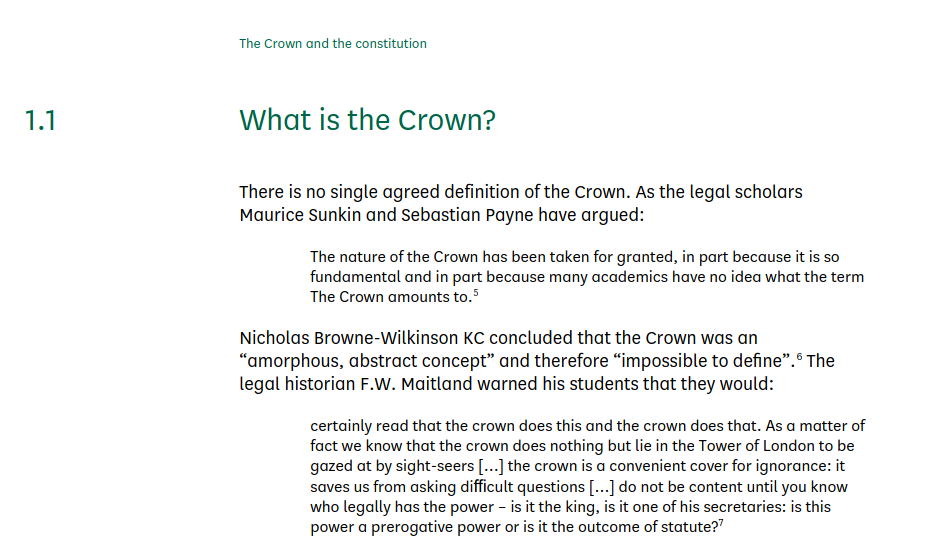
Source: David Torrance, House of Commons Library, The Crown and the Constitution, 4 August 2025;
the written ownership premise
sourcein paragraph 4 of the explanatory notes to the Land Registration Act 2002, it is written:
“The Crown is the only absolute owner of land in England and Wales: all others hold an estate in land.”
in paragraph 128, the authors also attribute dominion over all land to Crown as lord paramount;
the attribution is express; there is no mention of date or instrument by which a king surrendered his dominion to a Corporation Sole;
explanatory notes, paragraphs 4 and 128;
related sourceBlackstone described the supposed derivation of all English land from the King as a fiction; see the supposed royal grant;
Oxford English Dictionaryinvention, n.
I.2. The action of devising, contriving, or making up; contrivance, fabrication.
II.8. A fictitious statement or story; a fabrication, fiction, figment.
Crown copyright
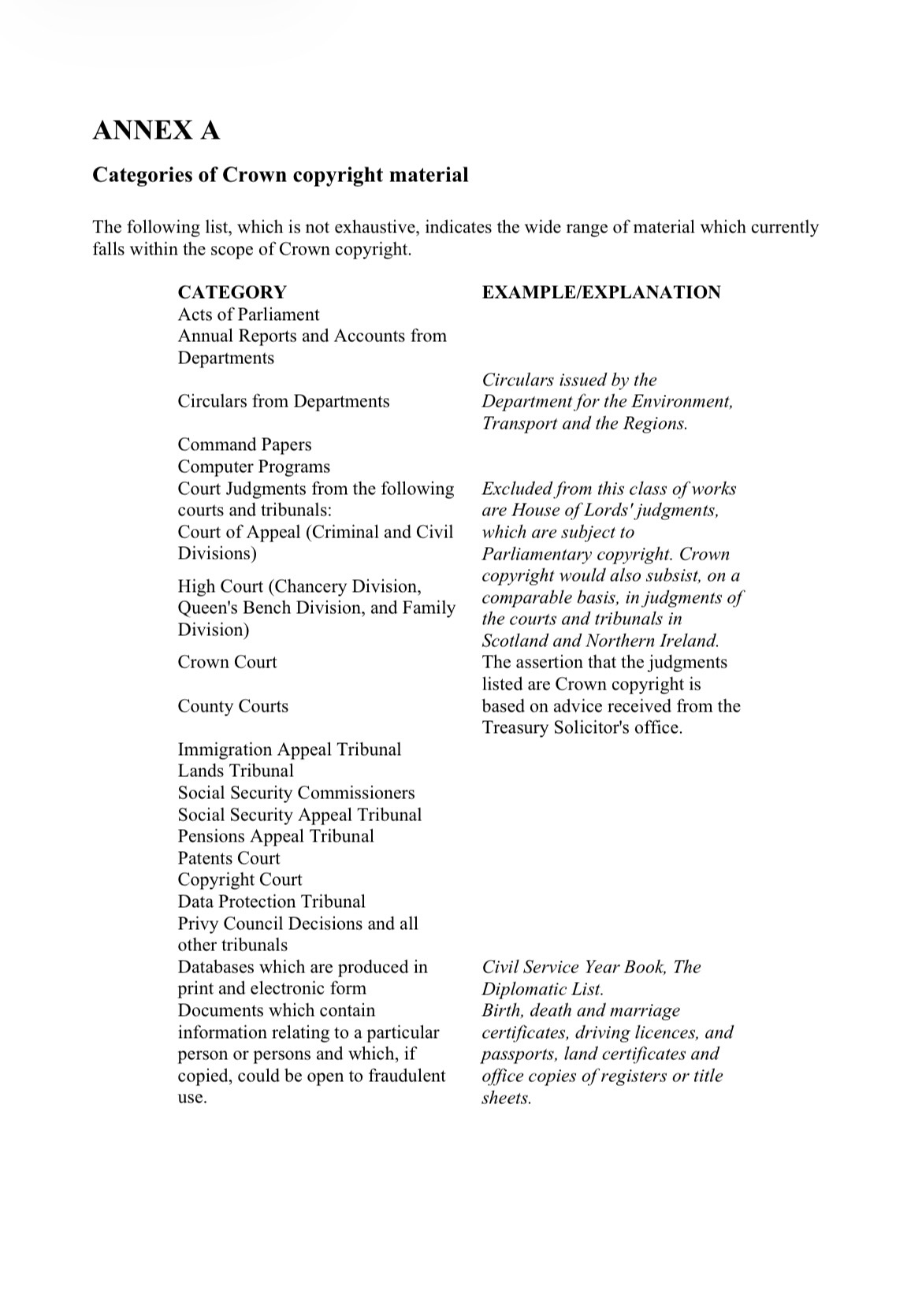
Source: Crown Copyright in the Information Age, January 1998; Annex A: non-exhaustive;
Crown, fiction and its styles
David Torrance writes that the monarch and the Crown are related but separate, and reports a Corporation-Sole account of the Crown; William Blackstone writes that corporations are artificial persons and that the King is a sole corporation;
sourceCopyright, Designs and Patents Act 1988, section 163: qualifying work “made by His Majesty or by an officer or servant of the Crown”; “His Majesty is the first owner”; “Crown copyright”; section 164: “His Majesty is entitled to copyright in every Act”; “Crown copyright”;
man is man; “His Majesty”: is a style; King: is a title and office; Corporation Sole: is an artificial person; Crown: is an abstract concept; Crown-in-Parliament and Crown copyright: are categories; all of them are fiction; fiction can not do a deed; it is non sense;
© Crown copyright [year]: it is an implied claim; a fiction can not own a copyright;
Charles, King and the United Kingdom
the man, the royal capacity, and the state are described in the following sources;
| expression | what is referred to | evidence |
|---|---|---|
| Charles | the man proclaimed King of the United Kingdom, and of his other realms and territories; | in the proclamation of 10 September 2022, the participants proclaim Charles Philip Arthur George King of the United Kingdom; the territorial title is written “of the United Kingdom of Great Britain and Northern Ireland and of His other Realms and Territories, King”; proclamation and source; |
| Liege Lord Charles the Third | the designation used for Charles by the participants in the proclamation; | in the proclamation of 10 September 2022, they describe him as “our only lawful and rightful Liege Lord Charles the Third”; proclamation and source; |
| King / Crown in the official capacity | the continuing royal capacity described as a Corporation Sole, with perpetual succession; | Blackstone writes: “In this sense the king is a sole corporation”; in X v Lord Advocate [2025] UKSC 44, paragraphs 40–42, Lord Reed and Lord Burrows describe the Crown as a Corporation Sole and explain that, in some contexts, Crown means the Sovereign in his official capacity; Blackstone and the judgment; |
| United Kingdom | a sovereign country: an independent state recognised under international law; | FCDO officials list the United Kingdom in the Geographical names index on GOV.UK and explain the meaning of sovereign in the accompanying text; government records and captures; |
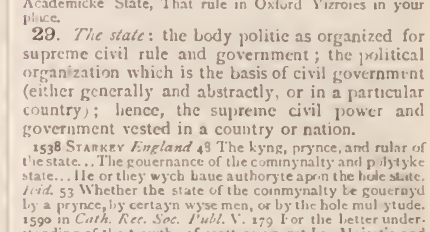
| United Kingdom as a state | a body politic, applying the cited dictionary meaning of state; | in the OED, state, n. 29.a, the definition begins “the body politic as organized for supreme civil rule and government”; OED evidence; see also /uk; |
see Maitland’s criticism of the royal construction and the opening words of letters patent;
- an imaginary thing can not receive, hold, own, license, or grant authority; it does not exist;
- the chain contains fiction;
- fiction can not cross the boundary into reality;
- to pretend it can is deceit;
see the historical development of Corporation Sole;
licence
sourcein section 163 and section 164 of the Copyright, Designs and Patents Act 1988, it is written that “His Majesty” is first owner of qualifying Crown work, is entitled to copyright in every Act, and that the copyright is called “Crown copyright”;
“His Majesty” is a mask for a man;
fiction can not own copyright;
sourceDavid Torrance, House of Commons Library, The Crown and the Constitution, writes that Crown is an “amorphous, abstract concept” and a “convenient cover for ignorance”;
Crown is an abstract concept, a mask of fiction; see prosopopoeia;
sourceon The National Archives website, it is written that the Keeper of Public Records manages Crown copyright under Letters Patent; Saul Nassé is presently named as the man holding the offices of Keeper of Public Records, King’s Printer and Controller of His Majesty’s Stationery Office, and as responsible for licensing Crown copyright;
Keeper of Public Records, King’s Printer and Controller of His Majesty’s Stationery Office are masks of a man; see personation;
fiction can not authorise;
sourcein the Open Government Licence v3.0, it is written that The National Archives developed the licence;
The National Archives is a named organisation, a mask of fiction; see prosopopoeia;
sourcein the Open Government Licence v3.0, “Licensor” is defined as an authorised Information Provider or the Keeper of Public Records for Crown copyright information;
“Information Provider” and “Licensor” are masks of fiction;
fiction can not offer information;
sourcein the Open Government Licence v3.0, it is written that “The Licensor grants you” a licence;
fiction can not grant;
fiction can not license;
applicationin the source, man kind substitutes styles, concepts, offices, organisations and defined names for man; each is a mask for fiction; none can perform the deed attributed to it;
none is a man; they are the masks of fiction that hide a man;
a man writes the licence and pretends the authority of Crown; see fraud;
fiction can not crossover to reality;
Crown fiction in everyday use
identity and personal records
- Driving Licence — the Secretary of State legally grants the licence under the Road Traffic Act 1988, section 97; Secretary of State for Transport is a Corporation Sole; fiction can not grant; see fraud;
- Birth Certificate — Certified Copy of an Entry (CCOAE) — a certified copy of an entry is provided under the Births and Deaths Registration Act 1953, section 30; Registrar General for England and Wales is a Corporation Sole; fiction can not certify; see fraud;
- Passport — the decision to issue belongs to the Home Secretary under the Royal Prerogative; HM Passport Office acts operationally on the Home Secretary’s behalf; Crown is an abstract concept; fiction can not issue; see fraud;
- other Annex A items: death and marriage certificates; land certificates; office copies of registers or title sheets; HM Land Registry forms for registering land; extracts from HM Land Registry; source: Crown Copyright in the Information Age, January 1998, Annex A, PDF pages 29–31;
- HM Land Registry material in Annex B: policy documents; consultation papers; newsletters; forms; the data-supply entry covers office copies of the register and filed plans, and register views on Direct Access; source: Crown Copyright in the Information Age, January 1998, Annex B, HM Land Registry row, PDF page 48;
law, road and official process
- MOT Test Certificate — the Road Traffic Act 1988, section 47 prohibits using a vehicle to which it applies on a road without a current test certificate; Acts of Parliament are Crown copyright; Crown is an abstract concept; fiction can not prohibit; see fraud;
- Act of Parliament — under the Copyright, Designs and Patents Act 1988, section 164, His Majesty is entitled to copyright in every Act; every Act is Crown copyright; fiction can not own; see fraud;
- other Annex A items: Statutory Instruments, Statutory Rules and Orders; court judgments and tribunal decisions; the Highway Code and Police and Criminal Evidence Code of Practice; Building Regulations;
forms, registers, maps and signs
- V5C Registration Document — under the Road Vehicles (Registration and Licensing) Regulations 2002, regulation 10(4), the Secretary of State shall issue a registration document to the keeper; Secretary of State for Transport is a Corporation Sole; fiction can not issue; see fraud;
- Postal Address and Postcode — the Postal Services Act 2000, section 116 requires the owner of the Postcode Address File to maintain it and make it available; Ofcom records Royal Mail as owner and defines Royal Mail as Royal Mail Group Limited; Royal Mail Group Limited is a company, an artificial person; fiction can not own; see fraud;
- HM Land Registry Title Register — paragraph 4 of the Land Registration Act 2002 Explanatory Notes states: “The Crown is the only absolute owner of land in England and Wales: all others hold an estate in land”; Crown is an abstract concept; fiction can not own; see fraud;
- HMRC Notice to File a Tax Return — under the Taxes Management Act 1970, section 8, a person may be required by notice to make and deliver a return; the Finance Act 2020, section 103 says HMRC may give that notice; HMRC comprises the Commissioners and officers of Revenue and Customs; the Commissioners act on behalf of the Crown; Crown is an abstract concept; fiction can not require; see fraud;
the substitution of Crown for King
sourceMaitland described the slow substitution of “the Crown” for King or Queen as a subterfuge.
findingThe substitution removes the natural man from the wording and attributes ownership, power and deeds to an abstraction capable of standing variously for the King in official capacity, government, State or organised community.
| date | source record |
|---|---|
| 1612; report published 1614 | in Sutton’s Hospital, Coke classified “the King, bishop, parson” as sole corporations; he wrote King, not Crown; |
| 1765 | Blackstone wrote that the King is a sole corporation; he wrote King, not Crown; |
| 1861 | Lord Cranworth stated obiter in Attorney-General v Köhler (1861) 9 HL Cas 654, 671; 11 ER 885, 892: “The Crown is a Corporation sole, and has perpetual continuance.” |
| from the 1860s | in the House of Commons Library briefing it is recorded that statutory references to “His” or “Her Majesty” began to be replaced with “the Crown”; |
| 1887 | in section 8 of the Pensions (Colonial Service) Act 1887, “permanent civil service of the State”, “permanent civil service of Her Majesty” and “permanent civil service of the Crown” are given the same meaning; |
| 1901 | in The Crown as Corporation, collected pages 257–259, Maitland called the slow substitution of “the Crown” for King or Queen one of “our subterfuges”; he wrote that habitual personification of Crown, particularly “the attribution of acts to the Crown”, was “much more modern than most people would believe”; he thought that in fully half the cases where Anson wrote “Crown”, Blackstone would have written “King”; he took it that, “in strictness”, Crown was not among the persons known to law unless merely another name for King; he recorded that formal records named King or Queen for suits, prosecutions, writs and letters patent; he would not stop the process making Crown a name for “a certain organized community”, but recorded that the term was being used in “three or four different, though closely related, senses”; he suggested that “the Crown” was often “a suppressed or partially recognized corporation aggregate” and described the sovereign lord as the head of a complex and highly organized “corporation aggregate of many”, while preferring the word “Commonwealth”; |
| 2025 | in X v Lord Advocate, Lord Reed and Lord Burrows wrote that, in some contexts, Crown means the Sovereign in official capacity; |
Maitland’s criticism of the royal construction
sourcein The Crown as Corporation (1901), Maitland called the application of Corporation Sole to the King “still more abortive and infinitely more mischievous”;
he argued that the two-bodies theory had not itself separated land held as King from land held as man, or public money from personal money; “All had to be done by statute”;
F. W. Maitland, Collected Papers, volume III, “The Crown as Corporation”, PDF page 118; read the extract below;
Corporation Sole: examples
there is no securely documented single invention date for Corporation Sole, and the surviving record does not show that it was invented for Crown; the device developed through ecclesiastical property and succession before Coke; Sutton’s Hospital concerned an aggregate corporation in 1612; in his report, published in 1614, Coke classified corporations as sole or aggregate and gave “the King, bishop, parson” as examples of the sole; Coke wrote King, not Crown; see the Corporation-Sole source chronology;
sourcein Halsbury’s Laws of England, paragraph 414, it is written: “A corporation sole is a body politic having perpetual succession, constituted in a single person”; in paragraph 415: “The Sovereign is a corporation sole”;
applicationin that Corporation-Sole account, body politic is a legal description of the continuing office; the words do not establish another natural body, and every deed remains the deed of the man who did it;
a Corporation Sole is an abstract concept, it is a fiction; here are some uses, any of which indicate that wherever it is relied upon, the outcome is falsehood;
| Corporation Sole | use | provision |
|---|---|---|
| Crown | property vested in Crown and succession; | Law of Property Act 1925, section 180 — property context; |
| Registrar General | birth and death registration; certified copies; | Registration Service Act 1953, section 1(2); |
| Secretary of State for Transport | V5C registration document and driving licence; | Secretary of State for Transport Order 1976, article 4; |
| Treasury Solicitor | property and deeds; unclaimed estates and dissolved-company assets; | Treasury Solicitor Act 1876, section 1; |
| Public Trustee | trust and estate administration; | Public Trustee Act 1906, sections 1 and 2; |
| Official Custodian for Charities | holds title to charity land despite changing trustees; | Charities Act 2011, Schedule 2, paragraph 1; |
| Housing Ombudsman | tenant and landlord complaint determinations; not a Crown chain; | Housing Act 1996, Schedule 2, paragraph 10; 2013 Corporation-Sole order; |
| police and crime commissioners; chief constables | police governance, staff and property; not every police act; | Police Reform and Social Responsibility Act 2011, sections 1–4 and Schedule 2; |
- the Secretary of State legally grants the driving licence under the Road Traffic Act 1988, section 97;
- Secretary of State for Transport is a Corporation Sole; a Corporation Sole is fiction;
- fiction can not grant, or cross over into reality; see fraud;
sources
source list
- David Torrance, House of Commons Library, The Crown and the Constitution, 4 August 2025, summary and section 1.1, pages 6–9: no single accepted definition for Crown; monarch and Crown related but separate; Crown vested in the King; Corporation-Sole account; page 30, note 114: statutory references to “His” or “Her Majesty” were replaced with “the Crown” from the 1860s;
- Copyright, Designs and Patents Act 1988, section 163 and section 164;
- William Blackstone, Commentaries on the Laws of England, Book I, chapter 18, star pages 467–470: corporations are artificial persons; the King is a sole corporation;
- Pensions (Colonial Service) Act 1887, section 8: “permanent civil service of the State”, “permanent civil service of Her Majesty” and “permanent civil service of the Crown” are given the same meaning;
- F. W. Maitland, The Crown as Corporation (1901), 17 Law Quarterly Review 131, pages 139–140; reprinted in collected papers, volume III, pages 257–259: slow substitution of Crown for King or Queen described as a subterfuge; Crown being made a name for an organised community; Crown considered as a suppressed or partially recognised corporation aggregate;
- X v Lord Advocate [2025] UKSC 44, paragraphs 40–42: Attorney-General v Köhler cited as supporting the Corporation-Sole characterisation; Crown, in the relevant context, means the Sovereign in official capacity;
- Crown Copyright in the Information Age, Cm 3819, January 1998, chapter 2; Annex A, PDF pages 29–32: categories of Crown copyright material, including land certificates, register or title-sheet copies, Land Registry forms and register extracts; Annex B, HM Land Registry row, PDF page 48: publications and data supply, including register copies, filed plans and register views;
- Intellectual Property Office, copyright guidance and The National Archives, copyright statements in official publications: no requirement of notice for protection; appropriate copyright-and-reuse statement required for government publications;
- Road Traffic Act 1988, section 97: the Secretary of State must grant a licence when the requirements are met; Secretary of State for Transport Order 1976, article 4: named office constituted a Corporation Sole; DVLA, about: Department for Transport executive agency responsible for issuing photocard driving licences and vehicle registration certificates; Road Vehicles (Registration and Licensing) Regulations 2002, regulation 10(4): the Secretary of State shall issue a registration document to the keeper;
- Postal Services Act 2000, section 116: the owner must maintain the Postcode Address File and make it available; Ofcom, PAF and postcode decisions, 7 April 2025: Royal Mail owns the File; Ofcom, designated universal service provider conditions: Royal Mail means Royal Mail Group Limited; Companies House, Royal Mail Group Limited: active private limited company;
- Land Registration Act 2002, Explanatory Notes, paragraph 4: “The Crown is the only absolute owner of land in England and Wales: all others hold an estate in land”; HM Land Registry, about: registers ownership of land and property in England and Wales;
- Taxes Management Act 1970, section 8: notice requiring a return; Finance Act 2020, section 103: HMRC may give the notice; Commissioners for Revenue and Customs Act 2005, section 4: meaning of HMRC; section 1(4): Commissioners act on behalf of the Crown;
- Road Traffic Act 1988, section 47 and MOT testing guide: obligatory test certificate; examination by an approved tester; result recorded;
- Births and Deaths Registration Act 1953, section 30 and section 33: certified-copy route; Registration Service Act 1953, section 1(2), inserted by Statistics and Registration Service Act 2007, section 68: Registrar General constituted a Corporation Sole; The National Archives and GRO certificate guidance: printed assertion of Crown copyright in the certificate layout; no ownership of its contents;
- Law of Property Act 1925, section 180: property vested in a Corporation Sole, expressly “including the Crown”; Treasury Solicitor Act 1876, section 1; Public Trustee Act 1906, section 1 and section 2; Charities Act 2011, Schedule 2, paragraph 1;
- Housing Act 1996, Schedule 2, paragraph 10 and Housing Ombudsman annual report and accounts: Corporation-Sole administration from 1 April 2013; Police Reform and Social Responsibility Act 2011, section 1 and Schedule 2, paragraph 2: police and crime commissioners and chief constables as Corporations Sole;
- Cabinet Office, Common Legislative Solutions: Corporation Sole in England, Wales or Northern Ireland; Scots law has no Corporation-Sole concept; legislation.gov.uk exact-phrase search: index requiring office-by-office status checks, not a central register;
- HM Passport Office, about: sole issuer of UK passports on behalf of Crown;
- Official Royal Prerogative guidance: the decision to issue belongs to the Home Secretary under the Royal Prerogative; HM Passport Office acts operationally on the Home Secretary’s behalf;
- Erskine May, enacting formula and UK Parliament, Royal Assent;
Maitland: The Crown as Corporation — text extract
F. W. Maitland, The Crown as Corporation (1901), Collected Papers, volume III; electronic edition, PDF page 118;
Meanwhile the concept of a corporation sole was being fashioned in order to explain, if this were possible, the parson’s relation to the glebe. Then came Coke and in his masterful fashion classified Persons for the coming ages. They are natural or artifical. Kings and parsons are artificial persons, corporations sole, created not by God but by the policy of man1
Abortive as I think the attempt to bring the parson into line with corporations aggregate—abortive, for the freehold of the glebe persists in falling into abeyance whenever a parson dies—the attempt to play the same trick with the king seems to me still more abortive and infinitely more mischievous. In the first place, the theory is never logically formulated even by those who are its inventors. We are taught that the king is tow “persons,” only to be taught that though he has “two bodies” and “two capacities” he “hath but one person2 .” Any real and consistent severance of the two personalities would naturally have led to “the damnable and damned opinion,” productive of “execrable and detestable consequences,” that allegiance is due to the corporation sole and not to the mortal man3 . In the second place, we are plunged into talk about kings who do not die, who are never under age, who are ubiquitous, who do no wrong and (says Blackstone4 ) think no wrong; and such talk has not been innocuous. Readers of Kinglake’s Crimea will not have forgotten the instructive and amusing account of “the two kings” who shared between them control of the British army: “the personal king” and “his constitutional rival.” But in the third place, the theory of the two kings or two persons stubbornly refuses to do any real work in the cause of jurisprudence.
We might have thought that it would at least have led to a separation of the land that the king held as king from the land that he held as man, and to a legal severance of the money that was in the Exchequer from the money that was in the king’s pocket. It did nothing of the sort. All had to be done by statute, and very slowly and clumsily it was done. After the king’s lands had been made inalienable, George III had to go to Parliament for permission to hold some land as a man and not as a king, for he had been denied rights that were not denied to “any of His Majesty’s subjects1 .” A deal of legislation, extending into Queen Victoria’s reign, has been required in order to secure “private estates” for the king. “Whereas it is doubtful,” says an Act of 18622 . “And whereas it may be doubtful,” says an Act of 18733 . Many things may be doubtful if we try to make two persons of one man, or to provide one person with two bodies.
spelling and footnote markers follow the linked electronic edition; footnotes are available in that volume;
the proclamation: Charles and the royal title
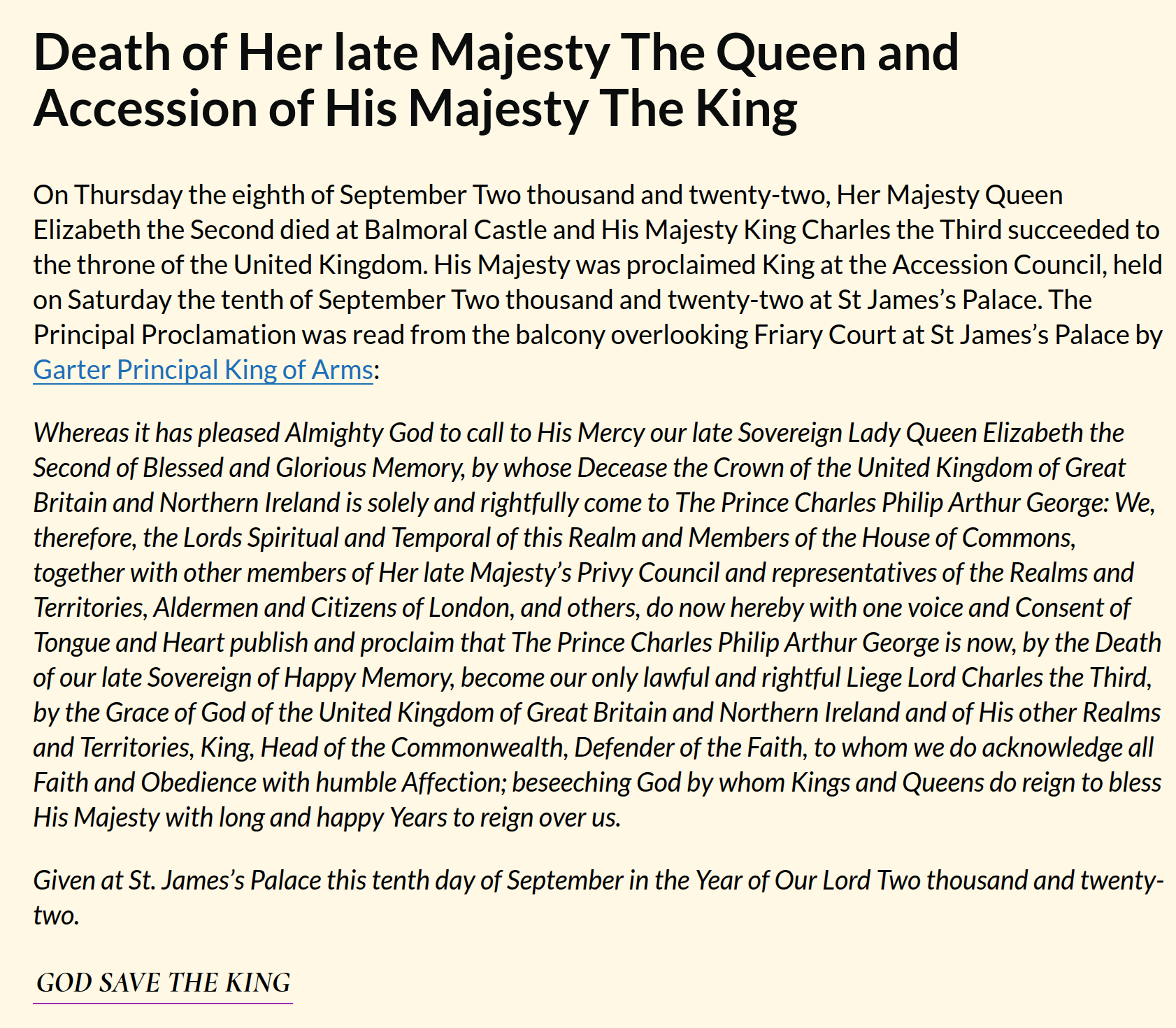
on 10 September 2022, the participants in the accession proclamation expressly named Charles Philip Arthur George and proclaimed him under the regnal name Charles the Third; the territorial title quoted in the table connects King with the United Kingdom of Great Britain and Northern Ireland and his other realms and territories;
the participants are described in the proclamation as Lords Spiritual and Temporal, members of the House of Commons and Privy Council, representatives of the realms and territories, aldermen and citizens of London, and others;
official Coronation Roll: accession and proclamation; return to the table;
the royal office: Corporation Sole and succession
in Commentaries on the Laws of England, Book I, chapter XVIII, Blackstone describes a sole corporation as one person and his successors in a particular station, with legal perpetuity; he expressly gives the King as an example, in the words quoted in the table;
Blackstone, Book I, chapter XVIII: Of Corporations; the long s is rendered as s in the quotation;
in paragraph 40 of X v Lord Advocate [2025] UKSC 44, Lord Reed and Lord Burrows describe a Corporation Sole as an office occupied by one natural person with perpetual succession; they connect that description with continuity of the royal office after the death of its holder, and distinguish the monarch’s private and public capacities;
in paragraph 41, they explain that, in some contexts, Crown means the Sovereign in his official capacity; in paragraph 42, they apply that understanding to the Crown Proceedings Act 1947;
judgment, paragraphs 40–42; compare Maitland’s criticism; return to the table;
the United Kingdom: government country records
in the FCDO Geographical names index, officials record GB, United Kingdom, and the formal name The United Kingdom of Great Britain and Northern Ireland; in the accompanying explanation on GOV.UK, they write: “‘Sovereign’ means that they are independent states, recognised under international law.”
Welsh Government officials also include the United Kingdom in Names of sovereign countries; they explain that their list reflects the FCDO index;

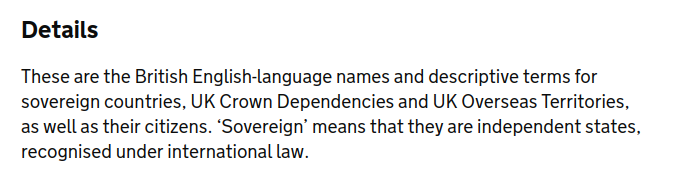
GOV.UK: Geographical names index; GOV.WALES: Names of sovereign countries; return to the table;
state and body politic: the OED wording
in the OED, state, n. 29.a, the editors use body politic for political organisation for civil rule and government; the connection in the table applies that dictionary sense to the United Kingdom’s description as a state;